
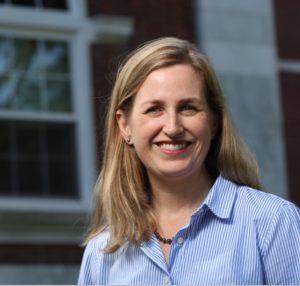
Helen B. Marrow, Ph.D.
I am a Professor of Sociology at Tufts University, where I teach and conduct research in the areas of immigration, emigration, race/ethnicity, research methods, Latino sociology, inequality, and health. I am a collaborating faculty member with Tufts’ Department of Latin American Studies (LAS), and in the past have also served as an Interim Director of the Program in Latino Studies. In May 2019, I was awarded the Lillian and Joseph Leibner Award for Excellence in Teaching and Mentoring. In 2020-22, I served as Co-Chair of the Executive Committee of the Faculty of Arts & Sciences and Engineering, and I currently serve as Co-Chair of the Faculty Research and Awards Committee of the Faculty of Arts & Sciences.
Beyond Tufts, I have served as Chair-Elect (2020-21), Chair (2021-22), and Past Chair (2022-23) of the International Migration Section of the American Sociological Association; been a Visiting Researcher at the Russell Sage Foundation in New York; and served as Co-Leader of the Boston-area Scholars Strategy Network (2015-16), which is an organization of scholars that seeks to make the democratic and policy implications of academic research more broadly accessible to the media, politicians, and American public.
My research and writing focus on immigration and emigration, race and ethnicity, social class, health, and inequality and social policy. My first sole-authored book, New Destination Dreaming: Immigration, Race, and Legal Status in the Rural American South (Stanford University Press, 2011) drew on 129 in-depth interviews and a year of participant observation to understand how Hispanic/Latino newcomers were being incorporated into or excluded from economic, social, institutional, and political life in “new immigrant destinations” of the rural U.S. South in the early 2000s. For this and other journal articles on the same topic, I was awarded the 2008 Best Dissertation Award from the American Sociological Association, the 2011 Distinguished Contribution to Research Article Award from the Latino/a Sociology Section of the American Sociological Association, and an Honorable Mention for the 2014 Distinguished Early Career Award from the Section on Racial and Ethnic Minorities of the American Sociological Association. More recently, I have written several new book chapters and journal articles where I attempt to gauge how the restrictive turn in anti-immigrant sentiment and immigration enforcement since 2005 has impacted immigrants’ experiences and opportunities in new destinations, especially the South.
Other parts of my research have been published in various places. A paper on the spatial patterning of Latino, Asian, and Muslim immigrants’ perceptions of discrimination in the U.S. was we published in Politics, Groups, and Identities (2016) (with co-authors Daniel Hopkins, Jonathan Mummolo, Victoria M. Esses, Cheryl R. Kaiser, and Monica McDermott). A paper on heterogeneity in Mexican Americans’ assimilation patterns was published in Ethnic and Racial Studies (2014) (with co authors Richard D. Alba and Tomás R. Jiménez). Results from two earlier projects — the first on second-generation Brazilians’ racial and ethnic identities in the United States, and the second on first-generation Latin Americans’ racial and ethnic identities in Ireland — were both published in Ethnicities. Along with sociologist Mary C. Waters and historian Reed Ueda, I am co-editor of The New Americans: A Guide to Immigration since 1965 (Harvard University Press, 2007), a comprehensive guide to major themes in U.S. immigration research and to the national-origin immigrant groups present in the U.S. at the turn of the 21st century. Feel free to browse my publications pages for details and links to ones that interest you.
In the arena of health, my 2009 case study of the effects of San Francisco’s inclusive policy context toward unauthorized immigrants in health care was published in two special volumes on immigration and health in Ethnic and Racial Studies (2012) and Social Science & Medicine (2012). For that scholarship, I was awarded the 2010 Best Paper Award from the First Annual Research Training Workshop of the University of California Centers of Expertise on Migration and Health (COEMH). Later, I drew on that case study to team up with fellow sociologist and RWJ Health Policy alum Tiffany Joseph (Northeastern University) to analyze the implications of national (the Affordable Care Act) versus state and local (San Francisco and Massachusetts) health care reform policies on unauthorized immigrants’ access to care. That collaboration was published in the Journal of Ethnic and Migration Studies (2015) and awarded the 2017 Donald W. Light Award for the Applied or Public Practice of Medical Sociology from the Medical Sociology Section of the American Sociological Association. In June 2017, Prof. Joseph and I were also proud to announce a special edited Journal of Ethnic and Migration Studies issue featuring several interdisciplinary scholars’ work on the health of immigrants and ethnoracial minority groups during the early period of ACA implementation between 2010 and 2016.
My main focus over the past 15 years has been a large interdisciplinary project funded by the Russell Sage and Carnegie Foundations and entitled “The Study of Immigrants and Nonimmigrants in Atlanta and Philadelphia (SINAP).” In collaboration with political scientist Michael Jones-Correa (University of Pennsylvania), sociologist Dina Okamoto (Indiana University), and social psychologist Linda Tropp (University of Massachusetts-Amherst), we are using original survey data, in-depth interviews, and short field observations to examine patterns of cultural contact and threat among two U.S.-born groups (Whites and Blacks) and two foreign-born groups (Mexican and South Asian Indian immigrants) in metropolitan Philadelphia and Atlanta to investigate how immigration-driven diversity shapes patterns of intergroup threat, contact, trust, receptivity, and civic participation. We are still working on our book, but have published six journal articles from this project in the meantime: the first on how contact experiences shape welcoming among these four groups (Social Psychology Quarterly, 2018), the second on how contact and welcoming shape immigrants’ American identifications and attachments to the polity (RSF: The Russell Sage Foundation Journal of Social Science, 2018), the third on how contact between U.S.-born groups shapes their attitudes toward immigrants (Du Bois Review: Social Science Research on Race, 2019), the fourth on how feeling welcomed by the U.S.-born shapes the immigrants’ trust in Whites and Blacks, plus their levels of civic engagement (Annals of the American Academy of Arts and Sciences, 2020), the fifth on how skin tone shapes Mexican immigrants’ perceptions of discrimination (Social Psychology Quarterly, 2022), and the sixth on how South Asian Indian immigrants perceive and interpret their experiences of discrimination in a relational context (Social Psychology Quarterly, 2023). We continue to work on writing up results from this study in other scholarly journal articles and a long-term book manuscript, tentatively entitled Encountering Diversity: Blacks, Whites, and Immigrants in Segregated U.S. Cities. We have also presented results publicly at places such as the 2015 National Immigrant Integration Conference, two stakeholder meetings in Atlanta and Philadelphia in Fall 2016, and academic conferences such as IMISCOE in Europe.
In a second exciting venture, I teamed up with political scientist Amanda Klekowski von Koppenfels (formerly of the University of Kent at Brussels) over a decade ago, to study Americans’ “migration aspirations” to live abroad. We started our collaboration out seeking to model the selectivity and characteristics of Americans who revealed some migration aspiration to live abroad using a unique and nationally-representative survey that we conducted in summer 2014. Indeed, our first article was published in the International Migration Review and is one of the first studies that examines Americans’ migration aspirations from the point of origin, thereby complementing a growing literature on American emigrants who have gone ahead and made the leap. Later, we analyzed new data from a second wave of our survey, re-fielded in summer 2019, and published a second article online first in the International Migration Review where we explore how Americans’ aspirations to live abroad shifted (or not) in the wake of the 2016 U.S. Presidential election, depending on their political ideology, strength of national attachment, and levels of civic and political engagement. (You can see a recent writeup in the Washington Post featuring some of that study’s findings here.) Today, we are in the midst of analyzing data from a third wave of our survey, which we fielded both pre- and post-election in the fall of 2024 through the Cooperative Election Study (CES), with gracious support from Faculty Research Fund (FRF) and MUSE fellowship funding here at Tufts.
Looking ahead, I have applied for funding to begin a new study with sociologist Ken Chi-Yan Sun (Villanova University) on the experiences of highly-skilled foreign students and scholars who are currently living, studying, and working in the United States amidst a trifecta of “policy shocks” — including U.S. government changes to visa and immigration policies, to grant-making guidelines, and to the federal rules governing international research and collaboration. Stay tuned!
Prior to coming to Tufts, I served as a Robert Wood Johnson Postdoctoral Scholar in Health Policy (UC-Berkeley and UCSF, 2008-10); a European Network on Inequality Research Fellow (Harvard University and University College Dublin, 2006); a National Science Foundation Graduate Research Fellow (Harvard University, 2002-04 and 2005-06); a Research Fellow with the Multidisciplinary Program in Inequality and Social Policy (Harvard University, 2001-04); and a Foreign Language and Area Studies Summer Fellow with the U.S. Department of Education (Brazil, 2002). I received my M.A. and Ph.D. in Sociology and Social Policy from Harvard University, where I received four Certificates of Distinctions in Teaching, and my A.B. (summa cum laude) in Sociology and Latin American Studies from Princeton University, where I received a President’s Award for Academic Achievement in 1998 and was inducted into Phi Beta Kappa in 2000.
Publicly, I have been interviewed and quoted in Aeon, The Atlantic, CBS News, The Independent, the New York Times, the New York Times Magazine, the Chicago Tribune, the Miami Herald, National Public Radio, Harvard Magazine, Tufts Now, The Society Pages, Vanity Fair, the Washington Post, and a video documentary on immigration on YouTube. I have also authored columns on the economic and fiscal impacts of unauthorized immigration in American communities in Contexts, the potential effects of repealing Obamacare in North Carolina in the Raleigh News and Observer, and the importance of immigration reform to Mexican American assimilation in the Los Angeles Times (with Tomás R. Jiménez) and the Raleigh News and Observer. I am currently a member of the Scholars Strategy Network (Boston chapter) and a faculty affiliate of the Center for American Political Studies and the Migration and Immigrant Integration Workshop at Harvard University. Previously at Tufts, I was designated one of the university’s Neubauer Faculty Fellows in 2011-12 and one of its Tisch Faculty Fellows in 2014-15. Feel free to browse my “Me in the News” page for details and links to ones that interest you.
I grew up — and continue to be proud of my roots — in eastern North Carolina. I now live in the Boston area with my husband and children. I like to cook, do yoga, hang out with friends and family, read, watch TV, and travel. I am proficient in English, Spanish, and Portuguese, and have even picked up a smattering of Italian, but unfortunately those learn-it-yourself French tapes and that one night course in elementary Mandarin never stuck! I’ve studied, worked, and/or volunteered in Belize, Brazil, Costa Rica, Ecuador, Ireland, Mexico, and Spain.